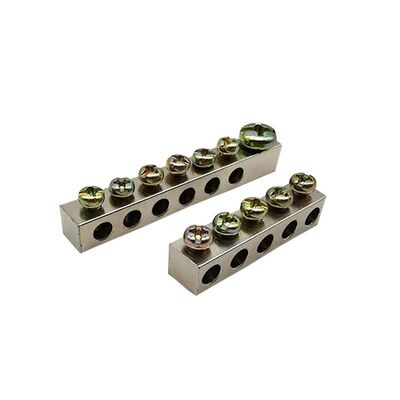
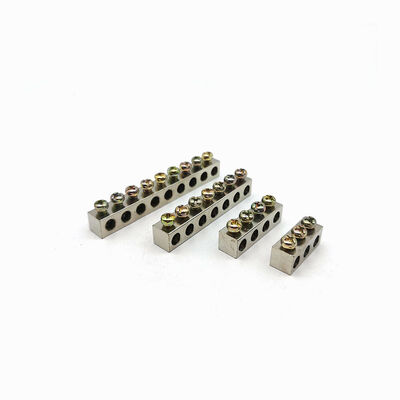
Copper Neutral Busbar 100A 2-8 Pole Tin-Plated DIN Rail Mounted UL Listed
What is a Neutral Busbar?
A neutral busbar is a metallic bar, strip, or terminal block found in electrical panels (like load centers, switchboards, and panelboards) that serves as a common connection point for multiple neutral wires . In AC electrical systems, it provides the return path for current to the source, completing the circuit. It is essential for load balancing, safety, and ensuring proper grounding within an electrical distribution system .
Material of Neutral Busbar
The base material directly impacts conductivity, cost, and application suitability.
1. Copper: Offers the highest conductivity. Often used in high-performance or "All Copper" panel specifications, though the neutral bar itself may still be plated aluminum in standard panels unless specified otherwise .
2. Aluminum: A common, cost-effective material for neutral bar in residential and commercial load centers, often specified as "tin-plated aluminum" .
3. Steel: Used in specific applications like support structures or busbar clamps, often electro-galvanized for corrosion resistance .
Surface Finishes
Finishes are critical for preventing corrosion (galvanic corrosion between dissimilar metals) and maintaining a low-resistance connection.
1. Tin Plating: The most common and preferred finish. It provides excellent corrosion resistance, maintains good conductivity, and prevents copper oxidation (copper green). It is compatible with both copper and aluminum conductors .
2. Electro-galvanized: A zinc coating applied to steel components (like mounting clamps) to prevent rust .
3. No Finish (Bare): Sometimes used, but prone to oxidation. Painting is considered an obsolete process for neutral bar functionality .
Specifications
| Material & Plating |
Must be verified (e.g Tin-Plated Aluminum; Bare Copper) to match the panel and connected conductors |
| Current Rating (Ampacity) |
Ranges significantly based on application; Examples include 140A for a standard 3x10mm bar up to 5700A for high-power industrial supports |
| Voltage Rating (Max Working Voltage) |
Typically rated for industrial environments up to 1000V or 1500V |
| Number of Terminations |
The number of connection points available for neutral wires |
| Wire Range |
The acceptable wire sizes for the terminal openings (e.g #14 - #1 AWG) |
| Flammability |
If housed in insulating material;it must meet standards like UL 94 V-0 |
| Temperature Range |
Must withstand operational environments; e.g -40℃ to + 130℃ |
Primary Applications
Neutral busbars are utilized wherever multiple circuits require a common return path.
1. Electrical Panelboards & Load Centers: Used as the main termination point for branch circuit neutrals in residential and commercial buildings.
2. Switchgear and Control Equipment: Provides organized neutral connections in industrial control panels .
3. Power Distribution: Essential in high-ampacity systems for data centers, wind turbines, and solar power generation .
4. Earthing Systems: Combined earthing and neutral bars are used to connect multiple grounding conductors within a panel .
Best Practice Application Example
Scenario: Adding a neutral termination point in a new industrial control panel.
An electrician installs an nVent ERIFLEX EBC-133 earthing and neutral busbar . Neutral bar is cut to length and mounted using insulating spacers to isolate it from the metal backplate. Multiple 4 AWG stranded copper neutral conductors are terminated using the pre-assembled clamps, which follow the screw vertically to ensure secure clamping force without damaging the strands. The tin-plated copper bar ensures a corrosion-resistant, low-impedance path for the return current, compliant with VDE and UL standards.